
Jennifer Keller • October 13, 2026
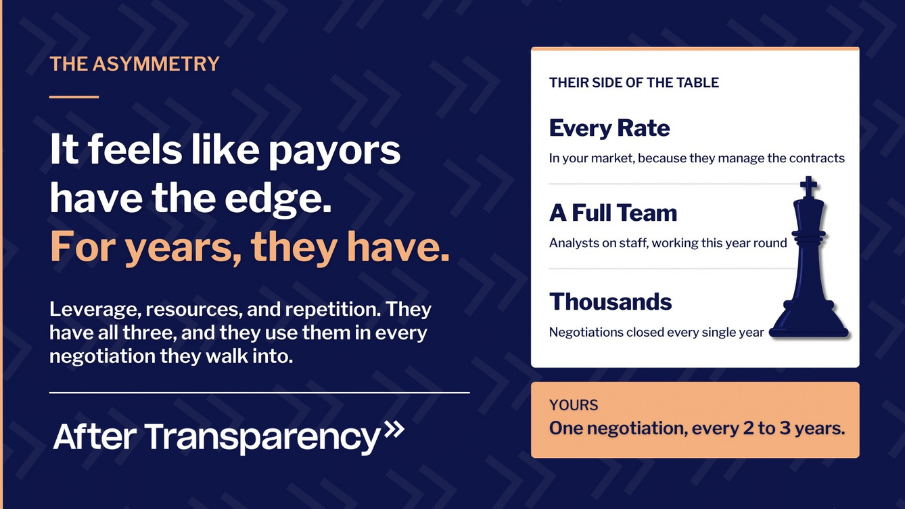
Payor and provider contract negotiations have been structurally asymmetrical for decades. Payors come to negotiations armed with the metrics and data points of every provider and market they’re connected to. They have dedicated teams of analysts and have accumulated experience at scale by handling so many negotiations every year.
By contrast, providers have traditionally been armed only with the insight and experience of their own negotiations, which typically happen only every couple of years. There is often just one point person, or a small team who revisits these contracts around the time of renewal. And if a provider has outside help, these resources have, in the past, acted more as middlemen between the parties than as advocates for the provider.
Payor Price Transparency data has opened a window of new opportunity for providers as they consider their next round of negotiations. Providers can now see not only their data but also how every other provider in the market is being reimbursed. Plus, with After Transparency in their corner, providers have the advantage of a team that exclusively supports them, not the payors, so there’s never a conflicting priority.
But access to this data alone won’t eliminate the payor’s edge. Providers must know how to read, interpret, and apply this data, and be ready to use those insights to negotiate from a position of informed strength.
Payors may have historically held the edge, but Price transparency gives providers an opportunity to balance the equation. And the right partner can help turn that new visibility into real negotiating leverage.
Provider Reimbursement Often Comes Down to Leverage
It’s a hard reality to know that you can handle the same procedure as the practice down the street, possibly even deliver care in a way that leads to better outcomes, and still be paid significantly less for it by the same payor. Why? Because a universal fee schedule doesn’t determine higher rates, and higher rates aren’t necessarily a reflection of better care. It’s all negotiated and often imbalanced, depending on which party has greater
leverage. In other words, as a provider, what you are paid can depend heavily on the relative bargaining power you and your payor each bring to the negotiating table.
This means two providers delivering similar care in the same market can walk away with very different reimbursement rates. Not because the services are different, but simply because the contracts are.
The data bears this out. The
Congressional Budget Office (CBO) has found substantial variation in the prices payors pay for the same services across physician practices and geographic areas. According to the CBO, these differences can be driven by relative bargaining power, rather than by differences in the care being delivered.
In
one study cited by CBO, even within the same provider group, negotiated prices for physician office visits were, on average, 21% lower for payors with a market share of at least 15% than for payors with a market share of 5% or less. In other words, leverage matters in a negotiation.
The Advantage of Resources and Repetition
The imbalance between payors and providers can also be attributed to the
resources each side brings to the negotiating table. Large payors have teams dedicated to contracting and network management. These teams are supported by analysts, actuaries, data, and systems built around the business of managing provider relationships. Contracting isn’t just something they make time for periodically; it’s what they do every day.
By contrast, for most providers, and particularly independent practices, the reality looks very different. Contract negotiations often fall to a practice administrator, CFO, revenue cycle leader, or a C-suite executive who can step in and manage the operation. They often do this alongside a litany of other responsibilities. Additionally, because provider contracts operate on multi-year cycles, the person or team responsible for this effort may consider a particular payor agreement only once every few years.
This difference creates another power advantage for payors:
repetition. Payors negotiate contracts across large provider networks year after year. With every negotiation, they accumulate experience and institutional knowledge. They know the objections providers are likely to raise. They’ve heard the counteroffers. They know which arguments tend to move a negotiation forward, where they have room to give, and where providers have historically accepted less.
The issue isn’t just that provider teams are less experienced in this area. It’s that they’re often walking into a negotiation against a larger, better-trained team with greater depth of resources and far more opportunities to hone their skills. When one side negotiates as a core function of its business and the other does it periodically, experience itself gives you the upper hand.
Leveling the Playing Field
For the foreseeable future, payors will continue to have more
leverage, greater
resources, and higher rates of
repetition on their side. Payor price transparency data doesn’t erase all of those advantages, but it does give providers something they haven’t historically had: greater visibility into the market they’re negotiating within. And armed with this critical information, providers are seeing results!
Providers can now access the data and insights payors have long held at their disposal. That creates an opportunity to walk into a negotiation with answers to questions that were once difficult, if not impossible, to answer:
Are we being reimbursed below market? By how much?- Where are the largest gaps between our rates and comparable rates in our market?
- Which payors represent our greatest reimbursement opportunities?
- What market evidence supports our counteroffer?
But access to the data alone won’t answer these questions. The Transparency in Coverage files are massive and complex. Whether you download them yourself or gain access through a vendor’s portal, simply having the data is not the same as knowing what to do with it. The
real advantage comes from being able to find the right data points, interpret the answers in context, identify meaningful opportunities, and turn all those findings into a negotiating advantage.
It’s true, the data can help level the playing field. But the intelligence needed to use that data is where the real advantage lies. And that’s where After Transparency delivers real value.
We don’t hand our clients a portal, login, or another massive dataset and leave them to figure things out on their own. We bring to the table our dedicated resources and the experience of repetition, giving our provider clients the advantage they’ve needed all along.
Our team of analysts works in this data every day. We know how to navigate the files, identify meaningful comparisons, uncover reimbursement gaps, and translate millions of data points into the handful that matter for your negotiation. Then we work alongside your team to understand what those findings mean and where the greatest opportunities exist.
Payors may still have scale. They may still negotiate more deals more often. But providers no longer have to walk into the room without their own legitimate market intelligence. For the first time, providers have the opportunity to see the playing field more clearly and to negotiate accordingly. Providers, you now have an edge, too.
-------------
Let’s Talk: After Transparency is a Nashville-based analytics firm that decodes federally legislated payor transparency data—transforming massive, complex datasets into precise intelligence. We’re an analytics partner, not a data dump. We work directly with clients to understand their strategic priorities, payor mix, geography, and key codes, then deliver clear, decision-ready insights clients can act on immediately.
Book a meeting with us today to learn how we can put payor price transparency data to work for you.
Click to share
