
By Jennifer Keller
•
February 26, 2026
Leveraging Payor Price Transparency Data Is An Opportunity Providers Can’t Afford to Ignore Note: After Transparency is honored to be included in one of Hospitalogy's "10 Healthcare Consulting Reports Worth Reading.” Blake Madden originally shared aspects of this post in August 2025 in his Hospitalogy newsletter, which you can subscribe to here . Following a CMS rule enacted in 2023 and reinforced in 2025 , Payors are now required to publish negotiated healthcare pricing data. Providers have a huge opportunity to utilize this data to strengthen their market position, but to do so, they need to be aligned with the right partner. Blake Madden of Hospitalogy believes, “...effectively leveraging Payor Price Transparency Data may be the single highest-impact financial initiative a Provider organization can undertake.” His conviction stems from the reality that questions once impossible for Providers to answer are now within reach. Do we have the highest (or lowest) ED rates in our state? Is another hospital carving out inpatient procedures in our market? A Payor is asking us to move to OPPS (APC) billing, but is that the right change for our practice? Do my competitors discount HMO or ACA at the same percentage as I do? Are carve-outs possible for this Payor in this state? When used correctly, this data offers insight into competitive intel and real market rates, enables smarter decisions about service line expansion opportunities and risks, and more accurate rate setting. Providers of all sizes can now walk into a Payor contract renegotiation with unprecedented confidence (and data) to back their request for a more equitable reimbursement for services. And yet, for most Providers, these opportunities remain largely untapped. At a baseline, many are still unaware that this data is accessible to them. Others who’ve heard of it haven’t attempted to pull any value from it. And for those Providers who have attempted to leverage this data, the experience has frequently fallen short of the promise, with lots of frustration and little payoff. Let’s consider why this has been the case and how After Transparency is working to address these issues: Data integrity concerns : Problems and discrepancies still exist within Payor datasets. After Transparency consistently flags inconsistencies to oversight bodies. Providers understandably question whether they can trust what they’re seeing. Overwhelming dataset sizes : We’re talking hundreds of trillions of data points, refreshed monthly. Downloading and unzipping a Payor file is one thing. Processing it has turned out to be another. As highlighted by Hospitalogy , Abraham (Abe) Gage at UofL Health in Kentucky downloaded a transparency file from Anthem, unzipped it, queued up Python, and promptly crashed his computer. As it turns out, Abe’s story is not unusual. The infrastructure required to process these datasets is significant. Large systems may eventually adapt or acquire the data, but most independent hospitals and Provider groups cannot realistically invest the internal resources to then curate, rationalize, and interpret the ensuing data. It wasn’t until Abe partnered with After Transparency that his team was able to fully realize the potential of this data and see a positive impact for his organization. Unreliable or conflicted vendors : Some data vendors oversell their capabilities, while others deliver incomplete or poorly normalized datasets. In some cases, Providers have spent hundreds of thousands of dollars investing in the promise of Payor Price Transparency Data without actionable results. Possibly more concerning, many vendors work both sides of the table. They’re enabling Payors in negotiations while marketing themselves as Provider advocates. At After Transparency, we’ve taken a firm stance. We do not work with Payors. Our loyalty is to Providers and the patients they serve. We will not support both sides of the same negotiation. The persistence of old negotiation tactics : Despite the new transparency push, many Payors still attempt to maintain the upper hand and act as if they’re the only side with all the intel. If Providers lack full confidence in their data—either due to an untrustworthy data vendor or poor in-house data capabilities—Payors can smell blood in the water, and often pounce at the opportunity to dominate. In response, many Providers revert to old patterns and concede under pressure, taking whatever the Payor will give them. After Transparency equips clients to enter negotiations with clarity and the assurance of a strong position. With so many issues, the hesitation to persevere and make use of Price Transparency Data is natural. That’s why After Transparency was founded, and it’s why we take a different approach in supporting Providers. The After Transparency Difference We’ve invested the time, infrastructure, and expertise to solve these data challenges, so Providers don’t have to. Our efforts support both large health care organizations as well as smaller, independent practices (because we know they have more leverage than they think). Hospitalogy asserts: “Payor Price Transparency isn’t just a regulatory requirement—it’s a massive opportunity. With trustworthy, actionable data and experts like After Transparency in your corner, Providers can finally level the playing field in negotiations and enterprise decision-making.” As Pete Brumm , Founder of After Transparency, has highlighted, “we believe this data holds great value to identify market opportunities and reimbursement disparities. We’re here to equip Providers with data that is traceable, verified, and compliant, and the necessary analytic support that enables Payor negotiations that are finally fair and equitable.” After Transparency delivers transparent and up-to-date contracted rate intelligence. We put defensible analysis within reach of Providers, large and small. If you’ve been burned before, your hesitation is fair. But writing off Payor Price Transparency Data will be a costly mistake. If you’re ready to explore what’s truly possible or simply want an informed conversation about the possibilities available to your organization, connect with our team today. Come discover the After Transparency difference. Reach out to us here . While you’re at it, join the thousands of healthcare professionals who already get expert analysis on healthcare M&A, strategy, finance, and markets. Subscribe to Hospitalogy, created by Blake Madden, at hospitalogy.com .
By Christopher Parks
•
February 5, 2026
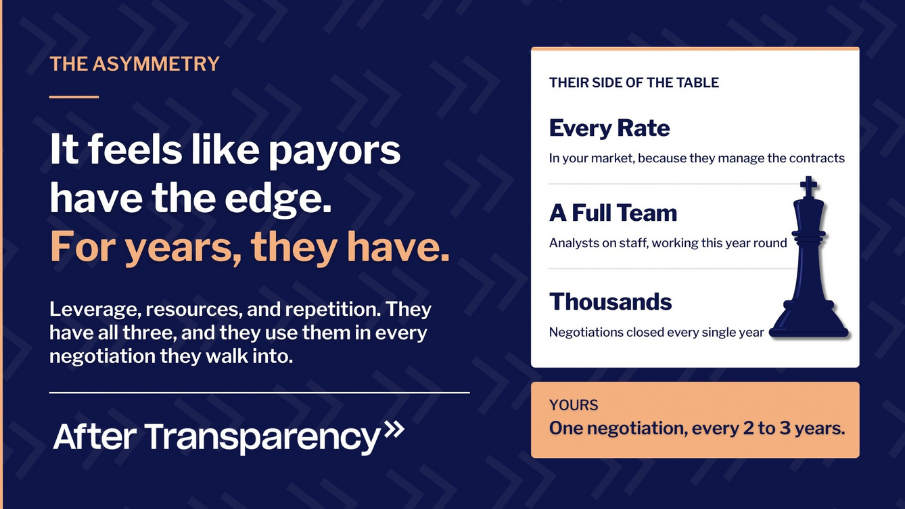
For all of my career, Provider contract negotiations with insurance companies (Payors) have felt like a rigged poker game. Payors, who play this game thousands of times a year, come to the table with a stacked deck and are able to see everyone’s cards. Meanwhile, Providers aren’t allowed to look at their own hand or see what cards others are holding. They’re expected to play blind. They can’t see how competitors are paid, and they can’t validate whether their rates are fair. Even when they attempt to improve their chances by purchasing data insights, they’re told the data is too sensitive to be shared, or worse, Payors swat aside their math as “wrong.” This wildly lopsided imbalance isn’t accidental, and even in today’s data-rich environment, it persists. That’s why I’m thrilled to announce I’m joining After Transparency as Chief Strategy & Development Officer , because I believe they can finally give Provider leadership teams competitive market clarity, necessary comparative precision, and the edge they need in their contract negotiations. The Monster We’ve All Been Fighting Recent price transparency regulations have cracked wide open what was once the industry’s biggest secret: negotiated rates between Providers and Payors. Unfortunately, what followed these federal mandates has been chaos, rather than clarity. A multitude of opportunistic tech and data vendors rushed to publish inadequate portals filled with averages, quartiles, and disconnected data points that lacked necessary context and curation.
These vendors raised the hopes of earnest Providers, then left them to do the hard work themselves—filtering, validating, and defending numbers they didn’t fully trust and couldn’t confidently present in negotiations. It’s been a mediocre experience at best. Without trust in their data, Providers lack the confidence to negotiate effectively. And uncertainty at the table is the fastest way to lose leverage with a Payor. On top of that, most transparency data vendors sell to Payors—enabling Payors to use this data during negotiations, putting Providers at an even greater disadvantage. After Transparency is a Different Kind of Company, Which is Why I’m Fired Up While other vendors were offering inadequate solutions, crashing their IT systems trying to download transparency files, or bragging about how much money they invested in parsing the Payor’s datasets, After Transparency had already built enterprise-grade infrastructure to ingest, analyze, and curate negotiated-rate data at extraordinary scale—we’re talking thousands of trillions of longitudinally connected pricing datapoints, refreshed monthly. And no, that’s not a typo. That data is transformed into precise, apples-to-apples, market-specific intelligence, down to the penny, that Providers of all types can actually use. Providers don’t have to invest or scale a team of analysts to ingest and interpret Payor datasets. After Transparency delivers clear, defensible insights that can improve negotiations, optimize revenue, support strategic service-line decisions, and reveal how a Provider truly compares in their market. Critically, After Transparency aligns exclusively with Providers. There’s no selling insights out the back door. No “leveling the playing field” by quietly empowering Payors. This tool is equipped with views even Payors don’t have access to, and After Transparency has no intention of undercutting Provider trust by sharing this important, proprietary intelligence with Payors. Results That Change the Game Simply having transparency data rarely moves the needle in reimbursement negotiations. What Providers need is trusted, curated intelligence with context. This information can then be shared, defended, and confidently used in negotiations. Since 2023, After Transparency has built a company and customer experience that stands apart. Operating less like a data vendor and more like a managed care insights partner, they handle data complexity with discipline and care so Provider executives can focus on strategy, not analysis. Each data delivery is curated with the Provider's unique market-specific nuances in mind. It’s this customer engagement philosophy, aligned with a simplified delivery approach, that engenders Provider trust. With access to this kind of intelligence, Providers are seeing remarkable results. Most have achieved significant results like the following: 45%–147% rate increases with major commercial Payors
Immediate lifts starting at 4% , scaling to nearly 50% on strategic DRGs
A 125% reimbursement increase in year one
Why This Matters For decades, confidentiality clauses and black-box analyses protected the status quo. Providers went into negotiations with outdated claims data, anonymized benchmarks, or reports that couldn’t be shared without being dismissed outright. Meanwhile, Payors could make claims that were nearly impossible to refute. That imbalance has real human consequences. When my mother was hospitalized near the end of her life, she was overwhelmed, not just by her health, but by uncertainty. She didn’t know if what she owed was fair, and she didn’t know how to find out. Worst of all, she felt powerless in a system that should have been clearer, fairer, and more humane. Ironically, while my mom’s story is from the perspective of a patient, Providers feel a similar powerlessness as they face Payors at contract renewal time. And here’s the thing: if insurers were truly good stewards, the data would show it. It would show that the best outcomes are rewarded, Academic medical centers would be paid for the burden they carry, Third party negotiators wouldn’t be locked out of negotiations, and Contracts would be understandable and terminable. But that’s not the world we’re operating in. Or at least, it hasn’t been. Thanks to new regulations, and After Transparency , things have the potential to change. Providers can identify where they’re leaving money on the table and walk into a negotiation with real data, not just guesswork, a hope, and a prayer. An Underdog Worth Fighting For I’ve always loved an underdog story. And the Provider–Payor power imbalance may be the biggest one in the U.S. economy. Hospitals are blamed for rising costs, yet the real question is: Are Payors fairly reimbursing Providers and are these tactics spurring consolidation as a result? After Transparency exists to answer questions like that with facts, not rhetoric. And we’re working to answer these questions for Provider groups of all shapes and sizes. Transparency regulations aren’t going away. Enforcement is increasing, and After Transparency is leading the way in identifying when Payors are not compliant in their data submissions. Providers who act now can gain a meaningful advantage. Those who wait will be negotiating from behind–against both competitors and Payors who already understand the terrain. I’m proud to join After Transparency and help Providers finally fight and win on equal footing. If you’re on the Provider side and want to talk about what transparency can look like when it’s done right, as well as the real impact it have in support of your organization -- I’d love to connect.

